
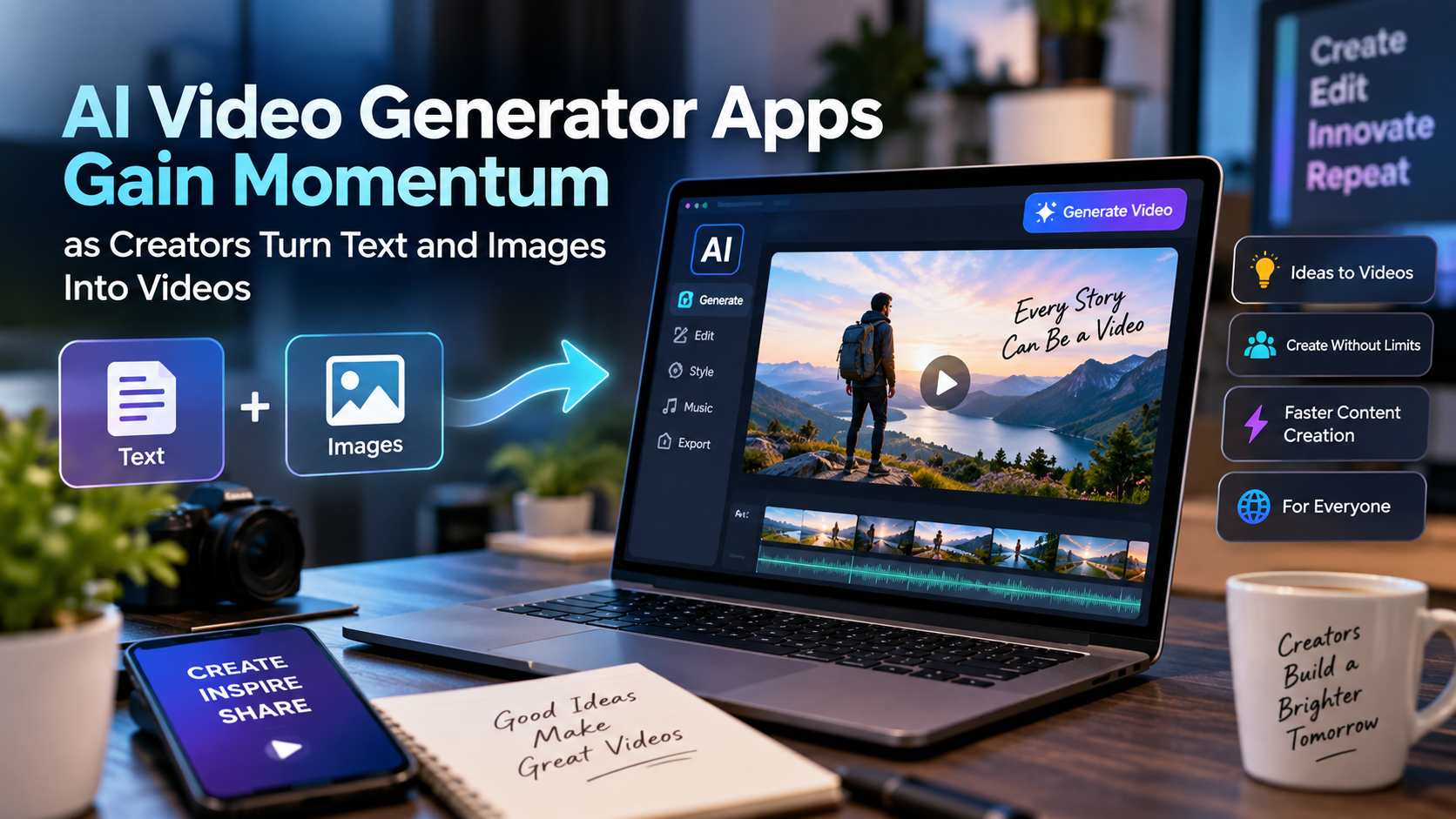
Creating a video used to mean cameras, editing software, lighting, scripts, and hours of work. Today, that process is changing quickly. AI video generator apps are allowing creators to turn simple text prompts and still images into engaging videos with far less effort. For influencers, marketers, small businesses, and everyday users, tools such as the VIBE AI Video app are making video creation more accessible. But why are these apps gaining so much attention, and what does this shift mean for the future of content creation?
Table of Contents
| Sr# | Headings |
|---|---|
| 1 | The Rise of AI Video Creation |
| 2 | How Text-to-Video Technology Works |
| 3 | Turning Images Into Moving Stories |
| 4 | Why Creators Are Adopting AI Video Apps |
| 5 | VIBE AI Video App and Easy Content Creation |
| 6 | Social Media Is Fueling Video Demand |
| 7 | Benefits for Small Businesses |
| 8 | AI Video for Marketing and Advertising |
| 9 | Making Professional-Looking Content Faster |
| 10 | The Role of Human Creativity |
| 11 | Challenges Creators Should Consider |
| 12 | The Future of AI Video Generator Apps |
| 13 | Tips for Getting Better AI Video Results |
| 14 | Conclusion |
1. The Rise of AI Video Creation
Video has become one of the most powerful ways to communicate online. People watch short clips while commuting, scrolling through social media, researching products, or simply looking for entertainment.
The challenge is that video production can be time-consuming and expensive. AI is helping change that equation. Instead of starting with a camera, creators can begin with a sentence, idea, photograph, or product image and allow an AI-powered app to turn it into video content.
This is one reason the VIBE AI Video app and similar platforms are attracting attention from people who want to create more content without spending hours learning complicated editing tools.
2. How Text-to-Video Technology Works
Text-to-video tools transform written instructions into visual content.
Imagine telling an app, “Create a cinematic sunset over a mountain lake with gentle camera movement.” Instead of searching for stock footage or filming the scene yourself, an AI video generator can interpret the description and produce a video based on the prompt.
The technology analyzes the words and translates them into visual elements such as scenery, movement, lighting, and composition. The result may not always be perfect, but the process can turn an idea into a usable starting point remarkably quickly.
For creators, it is almost like having a digital production assistant available whenever inspiration strikes.
3. Turning Images Into Moving Stories
Text is not the only starting point. Image-to-video generation is another major reason AI video apps are becoming popular.
A creator might have a product photograph, travel picture, illustration, artwork, or family-safe creative image. Instead of leaving it as a static picture, an AI tool can add motion and create a short visual sequence.
For example, a clothing brand could animate product images for social media. A travel creator could transform destination photographs into short promotional clips. An artist could experiment with movement and storytelling without recreating an entire scene manually.
This gives static images a new life.
4. Why Creators Are Adopting AI Video Apps
So, why are creators making the switch?
Speed is one of the biggest reasons. Online audiences expect fresh content regularly, and creators often need to produce several pieces of content every week. Traditional production can make that difficult.
AI video apps can reduce the time needed for early production tasks. Creators can experiment with concepts, generate variations, and decide what works before investing heavily in a full production.
Accessibility is another major advantage. Someone who has never used professional editing software can potentially create a short video using a simple interface and natural-language instructions.
5. VIBE AI Video App and Easy Content Creation
The appeal of the VIBE AI Video app is closely connected to this broader movement toward simpler video production. Rather than treating video creation as a specialist skill, AI-powered apps aim to make the process approachable for everyday users.
Creators can explore ideas using text and images, experiment with different concepts, and produce visual content without necessarily owning expensive equipment.
For beginners, that can remove a major barrier. Instead of wondering how to operate complicated editing software, they can focus on a more important question: What story do I want to tell?
That shift from technical execution toward creative thinking could become one of AI video’s biggest contributions.
6. Social Media Is Fueling Video Demand
Short-form video continues to dominate many social platforms. From product demonstrations to educational clips and entertainment, video is now a central part of online communication.
Creators therefore face a constant demand for fresh visual material. AI video generators can help fill that gap by making experimentation faster.
A creator could develop one idea and produce several visual versions for different platforms. A business could turn a written announcement into a short promotional video. A blogger could transform an article concept into a visual teaser.
The ability to repurpose ideas across formats makes AI video especially attractive to busy content creators.
7. Benefits for Small Businesses
Large companies may have dedicated creative departments, but small businesses often do not. A local store, independent consultant, online seller, or startup may need marketing videos without having the budget for a production team.
AI video generator apps can help level the playing field.
A business owner could create product introductions, social media clips, promotional messages, or simple educational videos from existing text and images. This does not eliminate the need for good marketing strategy, but it can make visual content easier to produce.
The biggest benefit may simply be flexibility: businesses can test ideas quickly rather than committing significant money to every video.
8. AI Video for Marketing and Advertising
Marketing teams are also exploring AI video because personalization and experimentation matter.
Instead of creating one video and using it everywhere, marketers can develop different versions for different audiences. Headlines, visuals, messaging, and formats can be adjusted according to the campaign.
This makes video production more adaptable.
However, good marketing still depends on understanding customers. AI can help produce the content, but it cannot replace a clear message, strong positioning, and genuine knowledge of what an audience wants.
9. Making Professional-Looking Content Faster
One of the most interesting developments is how AI is reducing the distance between an idea and a finished visual.
Previously, a creator might need to write a script, gather footage, record scenes, edit clips, add effects, and export the final video. AI can potentially assist with several stages of that workflow.
Think of it like moving from building a house brick by brick to having access to pre-built components. The creator still decides what the house should look like, but the construction process becomes faster.
That can give creators more time to focus on storytelling and audience engagement.
10. The Role of Human Creativity
Despite the excitement around AI, human creativity remains essential.
An AI tool can generate visuals, but the creator provides the purpose behind them. What should the audience feel? What message should they remember? What makes the story different?
These questions cannot be solved simply by pressing a generation button.
The strongest results are likely to come from a partnership between humans and AI. The person supplies the idea, judgment, personality, and direction, while the technology helps execute and explore that idea.
11. Challenges Creators Should Consider
AI video generation is powerful, but it is not flawless.
Consistency can be a challenge. Characters, objects, or visual details may not always appear exactly as expected. Some generated videos can also look artificial, especially when prompts are vague.
Creators should also think about copyright, permissions, privacy, and responsible use when working with images or other source material.
Most importantly, AI should be treated as a creative tool rather than an automatic replacement for human judgment. Reviewing every generated video before publishing remains important.
12. The Future of AI Video Generator Apps
The technology is moving toward a future where creating video may become as straightforward as writing a message.
We can expect AI video platforms to become easier to use, offer more control, and provide increasingly realistic motion and visual consistency. More creators may use AI not only for finished videos but also for storyboarding, concept development, advertising, education, and entertainment.
The biggest change may be cultural rather than technical: people who previously considered themselves “not creative” may begin experimenting with video simply because the tools are easier to access.
13. Tips for Getting Better AI Video Results
Want better results from an AI video generator? Start with a clear idea.
Be specific with your prompts. Describe the subject, setting, mood, movement, and desired style instead of using only a few generic words.
Start small. Short videos are easier to evaluate and improve.
Use strong source images. When creating image-based videos, a clear and well-composed image can provide a better foundation.
Experiment with variations. Your first generation may not be your best one. Try different descriptions and creative directions.
Finally, edit and review the result yourself. A little human refinement can make an AI-generated video feel much more intentional.
14. Conclusion
AI video generator apps are changing how people create visual content. By turning text prompts and images into videos, tools such as the VIBE AI Video app can make video production faster, more accessible, and easier to experiment with. The technology still has limitations, but its potential is difficult to ignore. For today’s creators, the real opportunity is not simply letting AI make videos—it is using AI to turn more ideas into stories worth watching.