
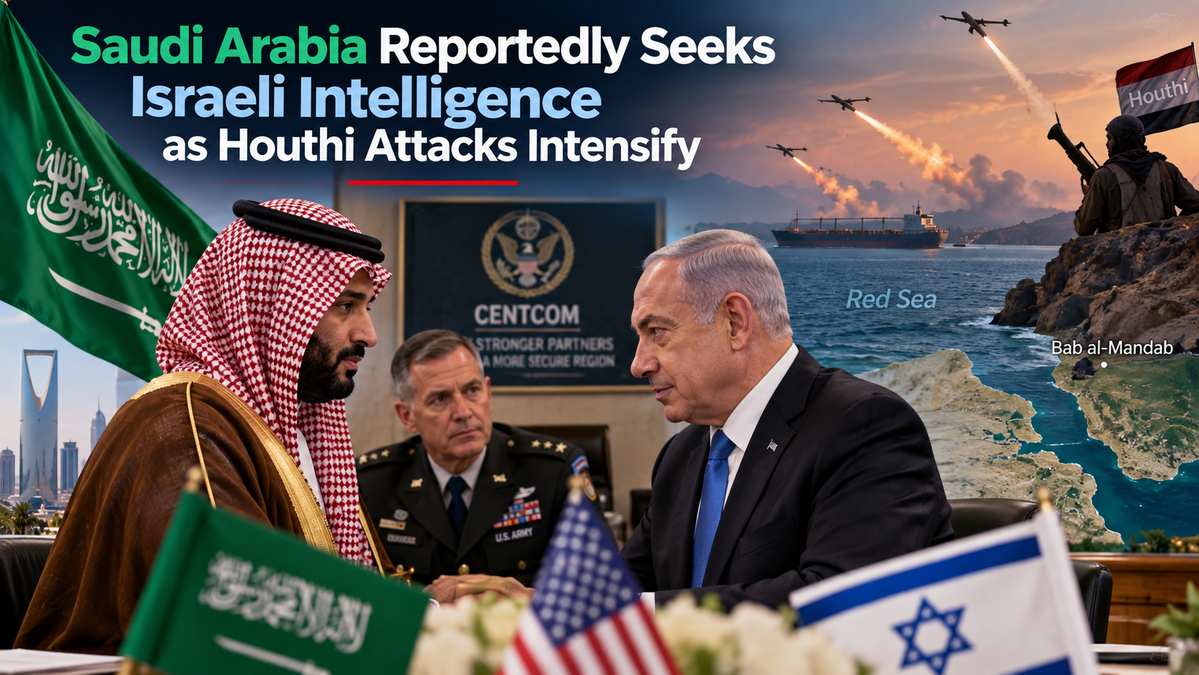
Saudi Arabia is reportedly exploring an unusual new channel for dealing with the growing threat from Yemen’s Houthi forces: intelligence assistance from Israel, facilitated through the United States.
According to regional diplomatic and security officials cited in recent reports, Riyadh has sought Israeli intelligence support to better track and understand Houthi military activity. The discussions are reportedly being conducted through U.S. Central Command, or CENTCOM, rather than through an openly declared Saudi-Israeli security arrangement.
The reported contact comes as Houthi attacks on Saudi Arabia intensify and the conflict increasingly threatens oil infrastructure, shipping routes and wider regional security.
The development is notable not simply because of the countries involved, but because it shows how rapidly security priorities can reshape relationships in the Middle East.
Why Riyadh Is Looking for More Intelligence
Saudi Arabia is facing a growing challenge from the Houthis, who have expanded their attacks across parts of the kingdom.
Recent warnings and reported missile and drone launches have placed several Saudi areas on alert, including regions around Najran, Khamis Mushait, Abha and Jizan. Other areas farther north along the Red Sea coast have also faced warnings.
For Saudi authorities, knowing where Houthi weapons, command centers and launch capabilities are located can be almost as important as having systems capable of intercepting incoming missiles.
That is where intelligence becomes critical.
The reported Saudi request to Israel is understood to focus primarily on gathering and analyzing information about Houthi military positions and intentions rather than an Israeli combat role inside Yemen.
The United States Is Reportedly Acting as the Bridge
The reported discussions are taking place through CENTCOM, the U.S. military command responsible for American operations across much of the Middle East.
That arrangement is significant.
Saudi Arabia and Israel do not have formal diplomatic relations, so a U.S.-mediated channel provides a mechanism through which security information can potentially be exchanged without requiring a direct public relationship between Riyadh and Jerusalem.
Reports from regional officials say Saudi Arabia approached Israel indirectly through CENTCOM for intelligence and other assistance against the Houthi threat.
The United States is already providing Saudi Arabia with security assistance, including reported air-defense, targeting and intelligence support.
The reported Israeli discussions would therefore fit into a broader effort by Riyadh to gather support from multiple partners rather than relying on a single military channel.
The Houthi Threat Is Moving Beyond Yemen
The urgency behind the reported request becomes clearer when looking at the geography of the latest attacks.
The Houthis have threatened to expand their operations deeper into Saudi territory. Recent Saudi warnings have covered areas that have not traditionally been central targets during the current phase of the conflict.
The group has also been expanding its influence around the Red Sea and the Bab al-Mandab Strait.
That waterway is strategically important because it connects the Red Sea with the Gulf of Aden and provides a major route for international shipping.
Any sustained disruption there can affect far more than Saudi Arabia.
It can alter shipping routes, increase transportation costs and put additional pressure on global energy markets.
Saudi Oil Infrastructure Adds Another Layer of Risk
The timing is especially sensitive because Saudi Arabia is already dealing with disruptions to its oil-export infrastructure.
The kingdom’s East-West Pipeline was shut after a drone strike earlier in September, forcing Saudi Arabia to consider alternative ways of moving crude to international markets.
The pipeline normally provides an important route for transporting oil toward the Red Sea while avoiding the Strait of Hormuz.
At the same time, Saudi Arabia has been increasing efforts to move oil through other routes as the regional conflict disrupts established energy corridors.
That creates a complicated security problem.
Saudi Arabia is not simply trying to protect cities. It also needs to protect the infrastructure that keeps its economy and global energy exports functioning.
Why Israeli Intelligence Could Be Valuable
Israel has extensive experience monitoring Iran and Iran-linked armed groups across the region.
The Houthis are backed by Iran, and their military capabilities include ballistic missiles, cruise missiles, drones and anti-ship weapons.
Israeli intelligence could potentially help Saudi Arabia understand Houthi movements, identify military infrastructure and assess changes in the group’s capabilities.
Reports indicate that the proposed assistance could resemble intelligence cooperation Israel already maintains with the United Arab Emirates.
That does not necessarily mean Saudi Arabia and Israel are forming a new military alliance.
It suggests something narrower: shared security concerns may be creating room for limited cooperation despite longstanding political differences.
This Is Not Simply a Saudi-Israeli Story
The reported intelligence discussions are part of a much larger regional effort.
Saudi Crown Prince Mohammed bin Salman has also been engaging other governments as Riyadh seeks support against the Houthi threat.
He met U.S. Central Command Commander Admiral Brad Cooper in Riyadh on September 14, with regional security and the Houthi campaign among the issues reportedly relevant to the discussions. He subsequently traveled to Egypt, where security cooperation and freedom of navigation in the Red Sea were also discussed.
Saudi officials have also sought assistance from the United States, Britain and European countries.
The message from Riyadh appears to be broader than simply asking one country for help: the kingdom is trying to build a wider security response to an increasingly complicated regional threat.
A Sign of Changing Regional Calculations
Perhaps the most interesting part of the story is what it says about the changing security environment.
Middle Eastern governments do not necessarily need to resolve every political disagreement before cooperating on a specific threat.
If Houthi attacks threaten Saudi oil facilities and shipping routes, Riyadh has an immediate practical reason to seek better intelligence wherever it can find it.
Israel, meanwhile, has its own security concerns regarding Iranian-backed groups and the movement of weapons and military technology across the region.
Those overlapping interests can create limited areas of cooperation even when broader diplomatic issues remain unresolved.
But the Reports Need to Be Kept in Perspective
The reported Saudi-Israeli intelligence discussions should not be interpreted as proof of a formal alliance or a major diplomatic breakthrough.
The information comes from regional diplomatic and security officials cited by multiple outlets, and the reported arrangement is described as being mediated by the United States.
There has been no publicly announced Saudi-Israeli defense agreement establishing a new joint military operation against the Houthis.
That distinction matters.
Intelligence sharing, diplomatic coordination and military intervention are three different levels of cooperation.
The reports currently point toward the first.
The Red Sea Is Becoming the Bigger Battlefield
The developments also highlight how the conflict in Yemen is increasingly connected to the wider Middle East security picture.
The Houthis’ ability to threaten both Saudi territory and maritime traffic gives them leverage beyond Yemen’s borders.
For Saudi Arabia, the challenge is therefore twofold: protect its territory while keeping critical energy and shipping routes open.
For international governments, the concern is even broader.
The Bab al-Mandab and Strait of Hormuz are both strategically important maritime corridors. Disruptions in either can have consequences for energy prices, shipping costs and global trade.
What Comes Next?
The immediate question is whether the reported intelligence cooperation develops into a more established security channel.
Much will depend on the scale and frequency of Houthi attacks, the condition of Saudi oil infrastructure and the ability of Riyadh and its partners to protect shipping routes.
For now, the reported discussions illustrate how quickly regional security calculations can change when critical infrastructure and maritime routes come under pressure.
Saudi Arabia’s reported outreach to Israel is therefore less about an overnight political realignment and more about an urgent search for information and security options.
Whether that cooperation remains limited to intelligence or expands further will depend largely on how the Houthi campaign—and the wider regional conflict—develops in the days ahead.