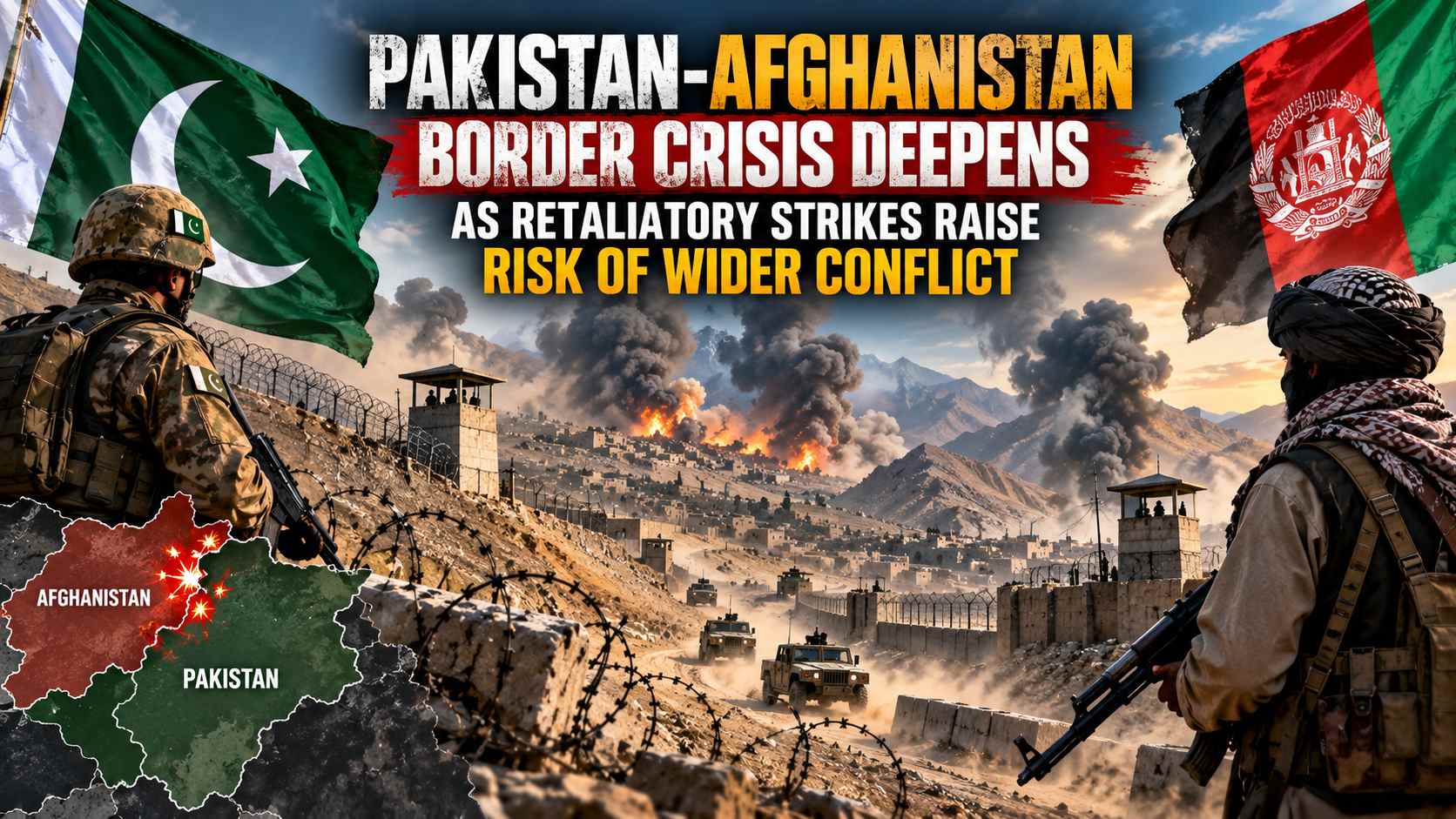
A fresh exchange of fire along the Pakistan-Afghanistan border has pushed relations between the two neighboring countries into another dangerous phase, with Pakistani security sources reporting that several Afghan Taliban fighters were killed during fighting in Balochistan.
The reported deaths have not been independently confirmed by either government. Pakistani sources said fighting continued intermittently in the Gulistan area, describing the incident as an attempted Afghan incursion into Pakistani territory.
But the latest confrontation is bigger than a single night of gunfire.
It is the newest episode in a cycle that has increasingly involved drones, airstrikes, border attacks and competing accusations. And with both Islamabad and Kabul showing little willingness to accept the other side’s version of events, the danger is that every new incident could become the trigger for another round of retaliation.
A Border Dispute That Is Becoming a Security Crisis
Pakistan says its latest military response came after drones crossed into its territory.
According to Pakistani Information Minister Attaullah Tarar, Pakistan carried out aerial and drone strikes against 10 locations inside Afghanistan on Thursday. Islamabad said the targets included militant hideouts as well as drone-launching and storage facilities.
Afghanistan’s Taliban government disputed Pakistan’s account and denied that its government had launched the drones involved in the earlier incident.
Afghan officials said the Pakistani strikes hit areas in Kandahar, Paktia and Khost provinces. Kabul also warned that it would provide an “appropriate response.”
That response now appears to be taking shape along the border, although the precise sequence and responsibility for the latest fighting remain disputed.
Why the Gulistan Fighting Matters
The Gulistan area is in Balochistan, close to the Afghan frontier.
Pakistani sources said Afghan Taliban fighters attempted to enter Pakistani territory and attack border positions. Security forces responded, killing several fighters, according to those sources.
Intermittent firing reportedly continued afterward.
The significance is not simply the number of casualties.
Every cross-border exchange creates pressure on both governments to demonstrate that they can defend their territory. That can make de-escalation politically harder, particularly when neither side accepts responsibility for starting the confrontation.
It is a little like a row in which every shove becomes justification for the next shove. The longer the cycle continues, the harder it becomes to determine where the original confrontation ends and the retaliation begins.
Pakistan’s Central Complaint: Armed Groups Operating From Afghanistan
Islamabad has repeatedly accused Afghanistan’s Taliban authorities of allowing armed groups to operate from Afghan territory and launch attacks into Pakistan.
At the center of that dispute is the Pakistani Taliban, or TTP, an armed group that has carried out numerous attacks inside Pakistan.
Pakistan argues that Kabul has not done enough to prevent militants from using Afghan territory as a base.
The Taliban government rejects the accusation that it shelters anti-Pakistani armed groups and has argued that militancy inside Pakistan is Islamabad’s own internal problem.
That disagreement has become one of the defining problems in relations between the two countries since the Taliban returned to power in Afghanistan in 2021.
The Conflict Has Already Crossed the Airspace
The current crisis did not begin with the latest border exchange.
Pakistan has already carried out several air operations inside Afghanistan this year, saying it was targeting militants responsible for attacks on Pakistani soil.
On September 21, Pakistan said its airstrikes killed 28 militants. Afghan officials, however, reported civilian deaths and injuries from those strikes. The UN has also raised concerns about civilian casualties resulting from cross-border violence.
The competing casualty claims demonstrate another problem.
Information coming from the battlefield is difficult to verify independently, meaning casualty figures and descriptions of targets can quickly become part of the political confrontation itself.
That makes careful attribution particularly important.
Kabul’s Response Could Determine What Happens Next
Afghanistan’s Taliban government has promised an “appropriate response” to Pakistan’s latest airstrikes.
That wording leaves considerable room for interpretation.
It could mean a diplomatic response, pressure through border forces or a military retaliation. At present, the available reporting does not establish the full scope of what Kabul may do next.
But any major retaliatory operation could create another Pakistani response.
That is where the real danger lies.
Neither side necessarily needs to want a full-scale war for one to become harder to avoid. A border incident, followed by retaliation, followed by another retaliation, can gradually produce a conflict neither government originally intended.
China, Türkiye, Qatar and Saudi Arabia Face a Difficult Mediation Task
The escalation also creates a problem for countries trying to mediate between Islamabad and Kabul.
China, Türkiye, Qatar and Saudi Arabia have been involved in diplomatic efforts aimed at reducing tensions and encouraging a more stable relationship between the neighbors.
The latest fighting threatens those efforts.
Mediation becomes particularly difficult when one side believes military action is necessary for self-defense while the other views that same action as an attack on its sovereignty.
Both governments can therefore claim they are responding rather than escalating.
That distinction may matter politically, but it does little to reduce the risk on the ground.
The Civilian Cost Could Grow Even If the Fighting Remains Limited
The immediate concern is not only whether Pakistan and Afghanistan exchange more fire.
Communities living near the border are also exposed to the consequences.
Airstrikes, artillery exchanges and armed infiltration can disrupt movement, damage homes and create new displacement even when military operations remain geographically limited.
Previous episodes this year have already produced civilian casualties, according to Afghan officials and UN reporting.
For people living along the frontier, the distinction between a limited military operation and a wider conflict can quickly disappear.
This Is No Longer Just About the Border
The deeper problem is that Pakistan’s security concerns and Afghanistan’s sovereignty concerns are now colliding.
Islamabad wants armed groups operating from Afghanistan to be contained.
Kabul does not want Pakistani forces carrying out attacks inside Afghan territory.
Neither position is easy to reconcile when trust between the two governments is already extremely weak.
The border therefore becomes the physical expression of a much larger political dispute.
And every new militant attack inside Pakistan increases pressure on Islamabad to act, while every Pakistani strike inside Afghanistan increases pressure on Kabul to retaliate.
A Dangerous Feedback Loop
The most worrying feature of the current crisis is its potential to become self-reinforcing.
A militant attack occurs in Pakistan.
Islamabad attributes responsibility to groups it says operate from Afghanistan.
Pakistan launches strikes.
Kabul condemns them as violations of Afghan sovereignty.
Afghan forces respond along the border.
Pakistan then describes that response as aggression.
And the cycle starts again.
Breaking that pattern will require more than military force.
It will require mechanisms that allow the two sides to verify accusations, investigate incidents and communicate before a border confrontation turns into a larger military operation.
Without such mechanisms, even a relatively small incident can become politically impossible for either side to ignore.
What Happens Next May Be More Important Than the Latest Casualty Figure
The reported killing of several Afghan Taliban fighters is significant, but the more important question is what follows.
Will the current exchange remain limited to isolated border positions?
Will Afghanistan retaliate for Pakistan’s airstrikes?
Will Pakistan conduct additional operations if attacks inside its territory continue?
Or will regional mediators succeed in creating enough space for both governments to step back?
Those questions remain unanswered.
What is clear is that the latest fighting has arrived after months of repeated accusations, military operations and fragile attempts at de-escalation. The border has become a place where an attack inside one country can rapidly produce consequences inside the other.
The Bigger Risk: A Conflict Neither Side Planned
Pakistan and Afghanistan have powerful reasons to avoid a prolonged conventional conflict.
Pakistan faces multiple security challenges and does not want its western border to become another sustained battlefield.
Afghanistan, meanwhile, remains economically and politically vulnerable and has limited room for a prolonged confrontation with its neighbor.
Yet avoiding a major war is not the same as resolving the dispute.
For now, the relationship appears trapped between those two realities.
The latest fighting in Gulistan may eventually prove to be a short-lived border clash. But if retaliation continues, it could become another step in a much larger cycle of confrontation.
The real test for Islamabad and Kabul is therefore not simply who controls the next stretch of border.
It is whether both governments can stop the next incident from becoming the next escalation.