Creative work has never been more accessible, but it has also never felt quite so expensive to maintain. In 2026, photographers, designers, video editors, marketers, and independent creators are taking a closer look at how much they spend on software every month. Many are asking a simple question: Do I really need another subscription? Understanding what is adobe creative suite has become part of that conversation because Adobe’s creative tools remain widely used, while newer and lower-cost options continue to attract budget-conscious users.
Table of Contents
| Sr# | Headings |
|---|---|
| 1 | Why Software Subscription Fatigue Is Growing |
| 2 | What Is Adobe Creative Suite? |
| 3 | The Real Cost of Creative Software |
| 4 | Why Creators Are Rethinking Monthly Payments |
| 5 | Affordable Alternatives Gain Attention |
| 6 | Free and Open-Source Tools Enter the Spotlight |
| 7 | AI Is Changing the Software Value Equation |
| 8 | Freelancers Feel the Pressure Most |
| 9 | Quality Versus Cost: What Really Matters? |
| 10 | How Creators Can Reduce Software Expenses |
| 11 | Will Subscription Models Survive? |
| 12 | The Future of Creative Software in 2026 |
1. Why Software Subscription Fatigue Is Growing
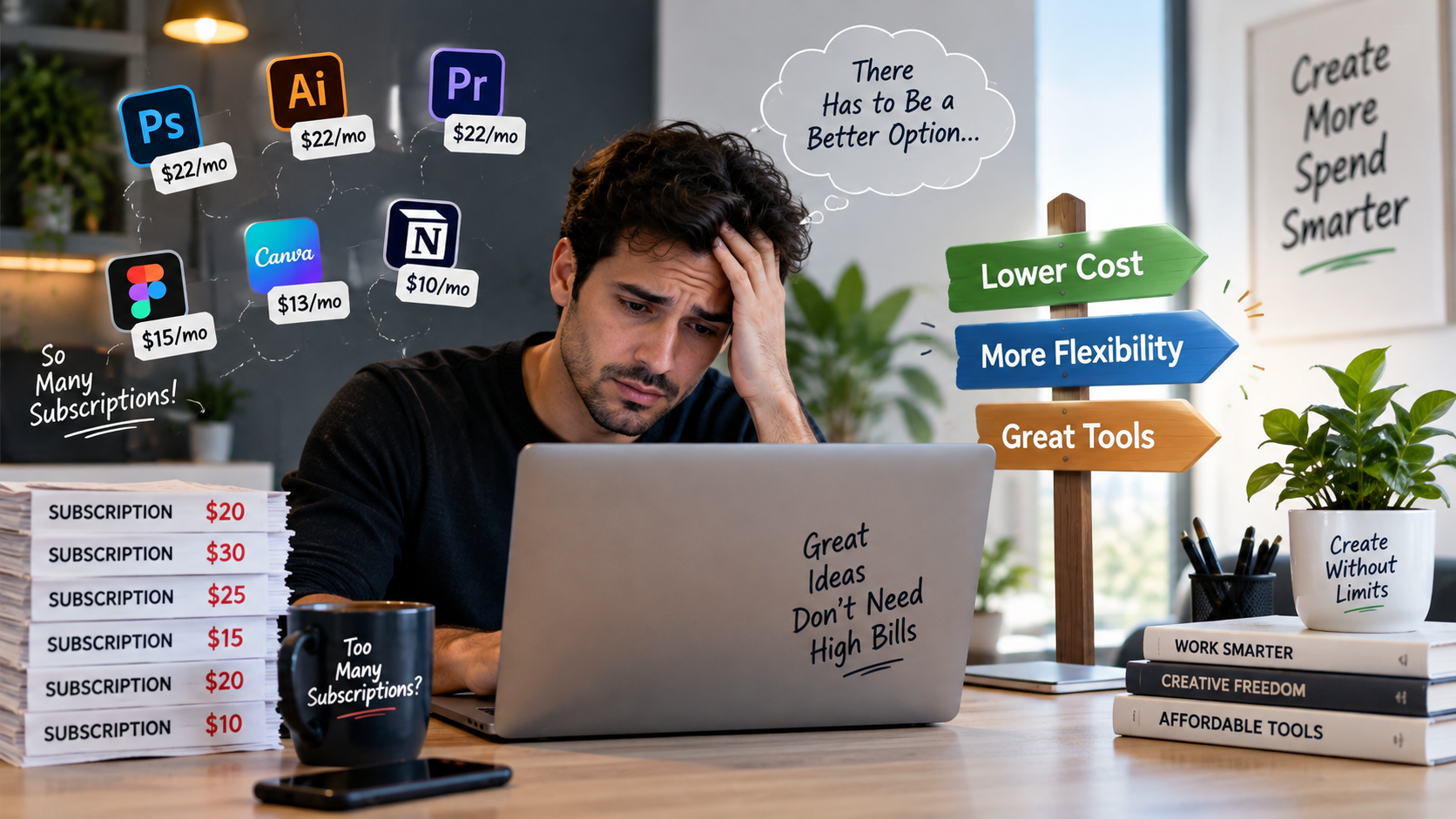
Subscriptions are convenient. You pay a regular fee, receive updates, and usually get access to a collection of features. But what happens when dozens of services follow the same model?
A creator might pay for photo editing, video production, design, cloud storage, fonts, stock images, music, project management, and AI tools. Individually, these payments may seem manageable. Together, they can become a surprisingly large monthly bill.
That is the heart of subscription fatigue: creators are no longer looking at software prices individually. They are looking at the total cost of their digital toolbox.
2. What Is Adobe Creative Suite?
So, what is adobe creative suite exactly? The term is commonly used when talking about Adobe’s collection of professional creative applications. Today, Adobe’s major creative offering is generally known as Creative Cloud, which provides access to applications used for graphic design, photography, video editing, illustration, and other creative tasks.
Popular Adobe applications include Photoshop, Illustrator, Premiere Pro, After Effects, and Lightroom. For professionals, these programs can provide a powerful and familiar workflow.
However, the subscription approach is also why Adobe frequently appears in conversations about software costs. Creators who previously thought mainly about buying software once now have to consider recurring expenses.
3. The Real Cost of Creative Software
The monthly price displayed on a website does not always tell the whole story.
Imagine buying a toolbox. The first tool costs $10, another costs $15, and another costs $20. None seems particularly expensive. But after adding twenty tools, the toolbox becomes costly.
Creative subscriptions work in much the same way.
A creator may subscribe to several services because each solves a different problem. Over a year, those recurring payments can represent a significant investment.
For established businesses, the expense may be justified by productivity and revenue. For students, hobbyists, and freelancers with inconsistent workloads, the calculation can be very different.
4. Why Creators Are Rethinking Monthly Payments
Creators increasingly want flexibility. Someone may spend three months producing videos for a client and then shift toward writing, photography, or social media work.
Why continue paying for expensive software during periods when it is barely being used?
Usage has become an important part of the value equation. Creators are asking whether software should cost the same every month when their workload changes dramatically.
This is especially important for independent professionals who have to manage their own equipment, marketing, taxes, storage, and business expenses.
5. Affordable Alternatives Gain Attention
The growing demand for cheaper creative software has created opportunities for competing platforms.
Some alternatives offer one-time purchases instead of subscriptions. Others provide lower monthly fees, limited free versions, or separate applications that users can buy individually.
This approach appeals to creators who do not need an enormous collection of features.
Why pay for 20 tools when you regularly use only three?
That question is becoming increasingly common among independent creators.
6. Free and Open-Source Tools Enter the Spotlight
Free software is also becoming more attractive.
Programs such as GIMP, Krita, Blender, and other community-supported applications can handle many professional and creative tasks without requiring a traditional subscription.
Of course, free does not automatically mean better. Some programs have steeper learning curves or lack certain industry-standard features.
Still, they provide something valuable: choice.
A creator can test a free application before deciding whether paying for premium software is actually necessary.
7. AI Is Changing the Software Value Equation
Artificial intelligence is another major factor in the 2026 creative software market.
AI-powered tools can help users remove backgrounds, generate images, edit videos, improve audio, resize designs, and automate repetitive tasks. As these features become more common, creators are reconsidering what they expect from traditional software.
The interesting question is not simply whether AI replaces creative programs. Instead, it is whether AI makes expensive software packages feel more or less valuable.
If a cheaper application can automate a task that once required a complex workflow, creators may have less reason to pay for premium tools.
8. Freelancers Feel the Pressure Most
Freelancers often operate with unpredictable income. One month can be extremely busy, while the next may be surprisingly quiet.
That makes fixed monthly expenses harder to justify.
A freelance designer might ask whether a subscription saves enough time to pay for itself. A YouTuber may compare the cost of professional editing software with simpler alternatives. A photographer might consider whether a full software package is necessary when only a handful of features are used regularly.
For independent creators, software is not just a tool. It is a business expense.
9. Quality Versus Cost: What Really Matters?
Cheaper software is not always the best choice.
Professional users may depend on familiar file formats, advanced features, plugins, color management, collaboration systems, or compatibility with clients.
Switching software can also take time. Learning a new interface is like moving into a new kitchen: the equipment may be good, but you still need to learn where everything is.
That is why the smartest approach is not necessarily choosing the cheapest option.
Instead, creators should compare price, features, workflow, compatibility, and actual usage.
10. How Creators Can Reduce Software Expenses
There are several practical ways to control subscription costs.
Audit your subscriptions. Make a list of every creative service you currently pay for.
Check your usage. Which programs do you use every week? Which ones have barely been opened?
Try alternatives. Free trials and free software can help you compare workflows before switching.
Consider bundled plans carefully. A bundle may look cheaper, but only if you actually use enough of its included services.
Look for flexible purchasing. One-time licenses or monthly plans without long commitments may work better for occasional users.
Small changes can make a meaningful difference over an entire year.
11. Will Subscription Models Survive?
Subscriptions are unlikely to disappear. They provide software companies with predictable revenue and allow them to release frequent updates.
But the market may become more flexible.
Creators increasingly expect different pricing choices, including free tiers, affordable individual applications, usage-based options, and one-time purchases.
The future may not be subscription versus non-subscription. It may be subscription plus choice.
Companies that give users more control over what they pay for could have an advantage as customers become more selective.
12. The Future of Creative Software in 2026
Software subscription fatigue reflects a broader change in how people think about digital products. Creators are no longer impressed simply because a platform offers hundreds of features.
They want useful features, reliable performance, reasonable pricing, and flexibility.
That does not mean established platforms have lost their value. For many professionals, Adobe’s ecosystem remains deeply integrated into creative workflows. But understanding what is adobe creative suite and comparing it with newer alternatives can help users make smarter purchasing decisions.
Conclusion
The creative software market is entering a more competitive phase in 2026. As subscriptions accumulate, creators are asking harder questions about value and necessity. Lower-cost alternatives, free tools, AI features, and flexible pricing are giving users more choices than ever. Ultimately, the best software is not necessarily the most expensive one—it is the one that gives you the features you actually need without putting unnecessary pressure on your budget.