
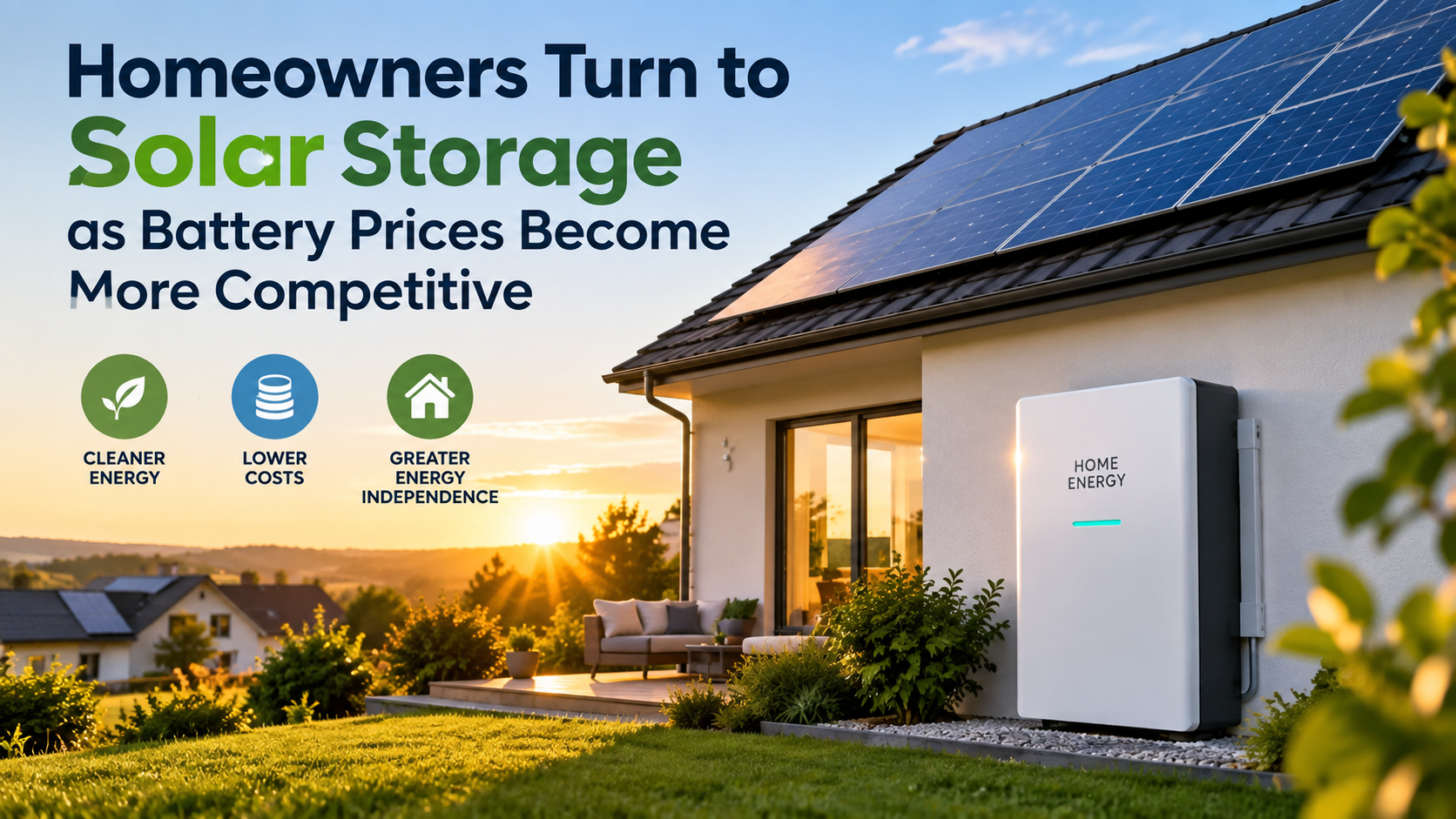
For years, solar panels have been one of the most popular ways for homeowners to lower electricity bills and use cleaner energy. But there has always been one major limitation: what happens when the sun goes down? Today, affordable home battery systems are changing that conversation. As battery prices become more competitive, more homeowners are considering solar storage as a practical way to save money, improve energy independence, and keep essential appliances running during outages. For anyone researching solar1000 solutions, the growing connection between solar panels and battery storage is worth understanding.
Table of Contents
| Sr# | Headings |
|---|---|
| 1 | Why Solar Storage Is Gaining Attention |
| 2 | Falling Battery Prices Change the Equation |
| 3 | How Home Solar Batteries Work |
| 4 | Solar Storage Can Reduce Electricity Costs |
| 5 | Backup Power During Outages |
| 6 | Why Energy Independence Matters |
| 7 | Battery Technology Is Improving |
| 8 | Choosing the Right Battery Size |
| 9 | Solar Storage and Smart Energy Management |
| 10 | What Homeowners Should Consider Before Buying |
| 11 | The Role of Solar1000 in Modern Energy Planning |
| 12 | The Future of Residential Solar Storage |
| 13 | Conclusion |
1. Why Solar Storage Is Gaining Attention
Solar power is no longer just about installing panels on a roof. Homeowners are increasingly looking at the entire energy system, including how electricity can be stored and used later.
Solar panels produce the most electricity during daylight hours, but many families use more power in the evening. Without storage, extra solar energy may be sent back to the grid or handled according to the homeowner’s utility arrangement.
A battery changes that pattern. Instead of letting unused electricity go to waste, homeowners can store it and use it when they need it most.
The result is simple: solar energy becomes more flexible and useful throughout the day.
2. Falling Battery Prices Change the Equation
One of the biggest barriers to residential energy storage has traditionally been cost. Batteries require a significant upfront investment, and homeowners naturally want to know whether the long-term benefits justify the price.
As battery manufacturing expands and technology improves, however, storage systems are becoming more competitive. Increased production, improved designs, and growing demand are helping make batteries more accessible to ordinary households.
Think of it like buying a laptop. Early models were expensive and limited, while today’s devices offer much more capability for the money. Home batteries are following a somewhat similar path.
Lower costs can make solar storage more attractive to homeowners who previously viewed batteries as too expensive.
3. How Home Solar Batteries Work
A residential battery works alongside a solar panel system. During sunny periods, the panels generate electricity. Some of that power can be used immediately, while excess energy can charge the battery.
Later, when solar production falls, the stored electricity can be used to power household devices.
The system can also be configured to prioritize certain appliances. Depending on the setup, a battery may help keep refrigerators, lights, internet equipment, medical devices, or other important electronics operating during a power interruption.
For homeowners exploring solar1000, understanding this basic relationship between solar generation and energy storage is an important starting point.
4. Solar Storage Can Reduce Electricity Costs
Electricity prices can vary depending on location, utility company, and time of day. Some homeowners may pay more when demand is high.
A battery can provide another option. Instead of purchasing as much electricity from the grid during expensive periods, homeowners may use energy stored earlier from their solar panels.
This can improve the value of the electricity generated by a solar system.
Of course, savings differ from one household to another. Utility rates, solar production, battery size, energy consumption, and local policies all influence the financial results.
5. Backup Power During Outages
Power outages are another major reason homeowners are becoming interested in batteries.
A traditional solar panel system may shut down during a grid outage for safety reasons. A properly designed battery-backed system can provide backup electricity when the grid is unavailable.
That does not necessarily mean powering every appliance in the house indefinitely. Instead, many homeowners choose to maintain essential circuits.
A battery can act like an emergency savings account for electricity—you build up stored energy before you need it.
This can be particularly useful during storms, extreme weather, equipment failures, or other unexpected interruptions.
6. Why Energy Independence Matters
Energy independence does not necessarily mean disconnecting completely from the electrical grid. For most homeowners, it means having greater control over where and when their electricity comes from.
Solar panels produce household energy, while batteries allow that energy to be saved for later.
Together, they can reduce dependence on grid electricity and give homeowners another layer of protection against changing energy prices.
For many families, that control is just as important as financial savings.
7. Battery Technology Is Improving
Modern home batteries are becoming more capable, compact, and easier to integrate with household energy systems.
Manufacturers are also focusing on durability, safety, monitoring, and improved performance. Smartphone apps and energy management platforms can allow homeowners to see how much electricity their solar panels produce, how much the battery stores, and how much energy the household consumes.
Better technology means homeowners can make more informed decisions about their energy use.
As innovation continues, residential storage is likely to become an increasingly normal part of new solar installations.
8. Choosing the Right Battery Size
Bigger is not always better when it comes to energy storage.
A homeowner needs to consider daily electricity consumption, solar panel capacity, backup requirements, and budget before choosing a battery.
A small battery may be enough for essential appliances during short outages. A larger system may make sense for a household with higher electricity consumption or greater backup needs.
The goal should be to match battery capacity with actual household needs rather than simply buying the largest system available.
Professional assessment can help homeowners determine an appropriate setup.
9. Solar Storage and Smart Energy Management
Battery storage becomes even more useful when combined with smart energy management.
Some systems can automatically decide when to charge or discharge based on household consumption, solar production, grid conditions, or electricity rates.
This reduces the need for homeowners to constantly monitor their systems.
Imagine having a smart assistant that quietly moves your electricity savings around the house at the right time. That is increasingly what modern energy management systems are designed to do.
10. What Homeowners Should Consider Before Buying
Although battery prices are becoming more competitive, homeowners should still look beyond the sticker price.
Important factors include battery capacity, usable storage, expected lifespan, warranty coverage, installation costs, system compatibility, and maintenance requirements.
Homeowners should also examine their electricity bills and understand how much energy they actually use.
Local incentives and utility policies may also affect the overall economics of a solar storage project.
Taking time to compare these details can prevent an expensive system from being installed simply because it looks impressive on paper.
11. The Role of Solar1000 in Modern Energy Planning
The growing interest in solar1000 reflects a broader shift in how people think about residential energy. Solar is increasingly being viewed as a complete energy strategy rather than simply a collection of rooftop panels.
For homeowners researching solar solutions, storage is an important part of the discussion because it addresses one of solar power’s biggest challenges: timing.
Generating electricity is only part of the equation. Being able to use that electricity when it is most valuable can make a solar investment more useful.
12. The Future of Residential Solar Storage
The residential energy market is changing quickly. As battery costs become more competitive, solar-plus-storage systems could become increasingly attractive to homeowners who want lower energy costs and greater reliability.
Future systems may offer better automation, longer operating lives, improved efficiency, and stronger integration with electric vehicles and smart home technology.
That could turn the home into something closer to a small energy hub—generating, storing, managing, and using electricity according to the family’s needs.
13. Conclusion
Home battery storage is moving from a niche technology toward a more practical option for everyday homeowners. Falling costs, better technology, backup capabilities, and greater control over electricity use are making solar storage easier to justify. Whether someone is exploring solar1000 or simply comparing renewable energy options, the key is to look at the complete picture. Solar panels generate the power, but batteries can help homeowners decide when that power is actually used.