
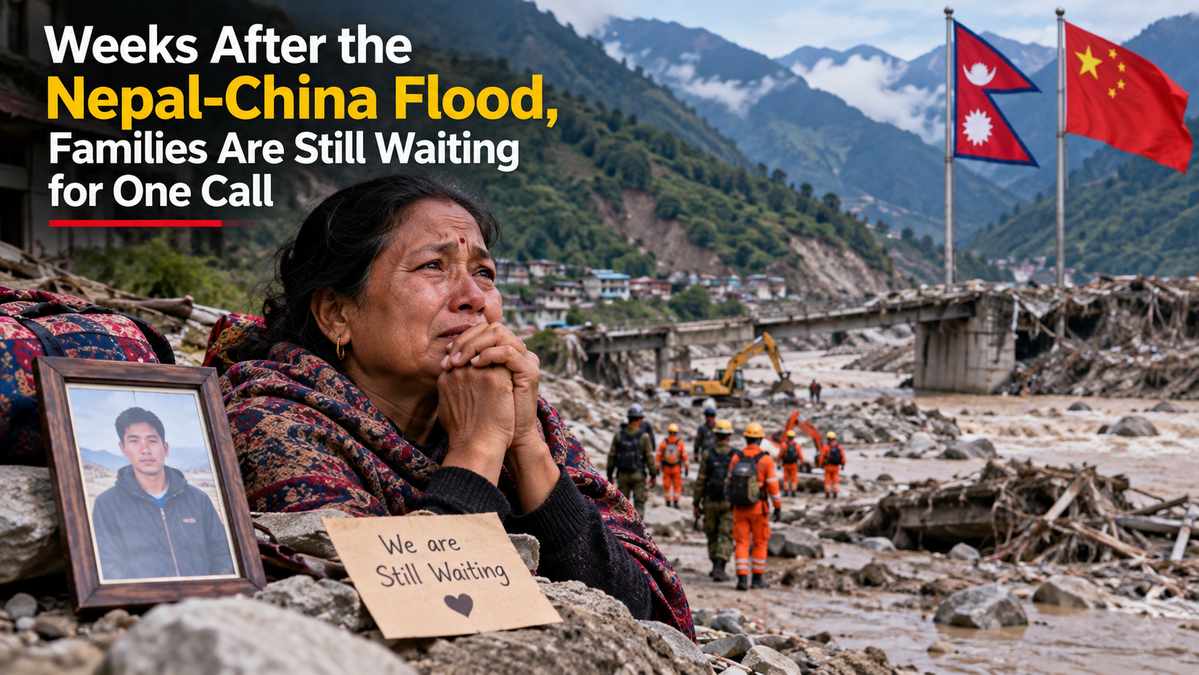
For the families of people missing after the catastrophic flood along the Nepal-China border, time has become both an enemy and a source of hope.
Weeks after a massive glacial collapse sent torrents of mud, rocks and water through valleys near the Himalayan border, thousands of people remain unaccounted for. For those families, the disaster is no longer just a headline about destroyed roads, homes and infrastructure. It is a daily wait for a phone call, a message or any piece of information that might finally explain what happened to someone they love.
Among them is the family of 33-year-old Indian consultant Arushi Gupta, who disappeared while traveling toward Tibet during a pilgrimage to Mount Kailash.
Her parents have refused to give up hope.
Arushi’s Last Message Became a Family’s Lifeline
Arushi had been keeping her family updated throughout her journey.
On August 26, the day the disaster struck, she sent her father a message saying she was about a 15-minute walk from the border. She also sent a photograph of the Gyirong Port immigration post.
Then the messages stopped.
Her father, Ajay Gupta, believes she may have made it across the border and reached higher ground.
That possibility has become something the family can hold on to while they wait for reliable information.
The family has contacted authorities in Nepal, China and India. Relatives traveled to Kathmandu, visited hospitals and checked lists of survivors and the dead. A DNA sample was also provided to help with identification.
Still, there has been no definitive news about Arushi.
For her family, uncertainty is painful—but it is also different from confirmation of death.
Thousands of Families Are Facing the Same Uncertainty
Arushi’s story is only one of many.
Reuters reported that 5,130 people remained missing in Nepal following the disaster, which had killed at least 1,386 people. On the Chinese side, 43 people had died and another 519 remained missing.
The disaster began when a huge mass of ice, rock and debris collapsed in the Himalayas, triggering devastating flooding along the Nepal-China border.
Entire sections of infrastructure were destroyed.
Roads disappeared. Border facilities were badly damaged. Hydropower projects were hit. Valleys were filled with enormous amounts of debris.
The destruction has made the search for missing people extraordinarily difficult.
The Search Has Produced Miracles—But Also Long Silences
There have been remarkable rescues.
Some hydropower workers were found alive after becoming trapped inside tunnels following the flood. One survivor, Sanjay Sah, spent nine days trapped underground before rescuers reached him.
Stories like his have given families another reason to keep waiting.
But rescue operations in the hardest-hit areas have also become increasingly difficult. Reuters reported that roughly 2.2 million tons of debris were deposited across the valleys, damaging settlements and infrastructure and complicating search operations.
As the immediate emergency phase has passed, families have faced another problem: fewer updates.
And when there is no information, people naturally fill the silence with questions.
For Families, Even Small Clues Matter
The families of missing people have created informal networks to share whatever information they can find.
Families connected to the Indian pilgrims, for example, formed a WhatsApp group with around 200 members. In the early days, relatives held regular calls and exchanged updates.
But as time passed, those conversations became less frequent.
That does not necessarily mean the families have stopped searching.
Instead, many have turned toward other possibilities, including mobile-phone location data, hospital records, DNA identification and information from authorities.
Arushi’s relatives have also sought assistance in determining whether mobile-phone data could provide clues about where missing travelers were last located.
A Similar Wait Is Playing Out in Europe
The uncertainty is not limited to South Asian families.
Vladyslava Horlova, a 22-year-old Ukrainian student living in Norway, is waiting for news about her mother, Elena, who disappeared near the border while traveling with a Ukrainian spiritual retreat group.
Horlova has contacted ministries, embassies and police departments in several countries. She has also provided a DNA sample to Norwegian authorities.
Like many other relatives, she is not asking for certainty about what happened. She wants information about where authorities have searched and what they have found.
That may sound like a small request, but for families living through an information vacuum, even a negative update can provide something they desperately need: clarity.
Technology Has Become Part of the Search
The disaster has also highlighted an unexpected role for technology.
Families have looked to smartphones, location services and mobile networks for clues that conventional search teams may not immediately be able to provide.
In Horlova’s case, Apple’s location system appeared to show different last-known locations for her mother’s phone and other devices.
That has led families to approach technology companies for help.
The difficulty is that location information is not necessarily the same as proof of where a person was when disaster struck. Devices can lose power, lose network access or remain in a location after their owner has moved.
Still, when conventional communication has disappeared, even imperfect digital traces can become important to families.
Why the Search Has Become So Complicated
The geography of the region is a major obstacle.
The disaster occurred in one of the world’s most difficult environments for rescue operations. Mountain terrain, destroyed roads, unstable debris and damaged infrastructure can make reaching affected areas extremely difficult.
Search teams are therefore dealing with more than the task of finding people.
They must also reach locations safely.
Earlier rescue operations demonstrated both the danger and the possibilities. Nepal’s hydropower tunnels became some of the places where survivors were eventually located, while large sections of the surrounding landscape remained buried or inaccessible.
Nepal’s Disaster Has Also Become a Regional Crisis
The consequences extend well beyond missing-person searches.
The flood damaged hydropower facilities that are critical to Nepal’s electricity system. Reuters reported that more than a dozen hydropower plants were swept away or severely affected, while Nepal temporarily had to rely more heavily on imported electricity.
India has since approved electricity exports to Nepal to help the country deal with the disruption.
Meanwhile, Nepal has appealed for international assistance for reconstruction, saying the disaster destroyed homes, roads, power infrastructure and other essential facilities.
The humanitarian search and the rebuilding effort are therefore happening at the same time.
For Families, the Disaster Has Not Ended
For people watching from outside the affected region, the flood may already feel like yesterday’s news.
For the families of the missing, it is happening every morning.
A phone that does not ring. A message that remains unread. A photograph from a journey that suddenly became the last known image of a loved one.
That is why some families continue to hold on to possibilities that others might find difficult to understand.
Arushi’s father is preparing to return to Nepal with his wife and son-in-law to continue looking for answers.
His hope is simple: that his daughter somehow survived.
“Miracles do happen,” he told Reuters.
The Waiting Continues
The Nepal-China disaster has already claimed thousands of lives and transformed communities across the Himalayan borderlands.
But the final human toll remains uncertain while thousands are still missing.
For their relatives, the most important development may not be another statistic about the disaster. It may be a name appearing on a survivor list, a confirmed location, a recovered personal item or a message from an official saying that someone has been found.
Until then, families continue searching, calling and waiting.
And in the silence left behind by the flood, hope remains one of the few things they can still hold on to.