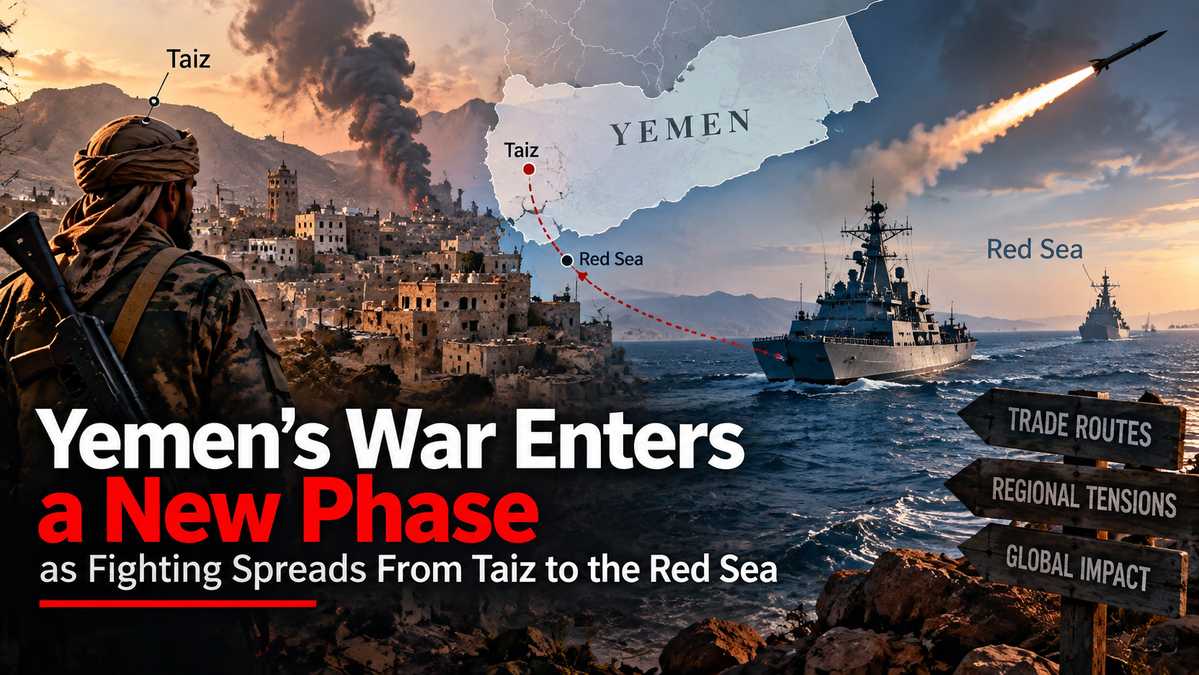
Yemen’s conflict is once again threatening to reshape the balance of power across the country.
Government forces have pushed forward in western Taiz after repelling a Houthi offensive, while the Houthis have continued making territorial gains elsewhere along Yemen’s western coastline and have claimed new attacks against Saudi Arabia.
What might look like a series of separate battlefield developments is becoming a much larger regional security problem.
The latest fighting is unfolding around territory that matters not only to Yemen’s rival factions but also to Saudi Arabia, Red Sea shipping and the strategically important Bab el-Mandeb Strait.
Government Forces Push Back in Taiz
Yemeni government forces have made advances in western Taiz after resisting a Houthi assault, according to Al Jazeera.
The development gives the internationally recognized government a battlefield gain at a time when the Houthis have been pressing their offensive along several fronts.
Taiz is particularly important because of its geography.
The province connects Yemen’s western coastal areas with the country’s interior, and control of key roads and high ground around the region can influence the movement of fighters, weapons and supplies.
For government forces, pushing the Houthis back around Taiz could therefore provide more than a symbolic victory.
It could create additional room to defend territory and challenge Houthi movements toward the coast.
But the Houthis Are Expanding Elsewhere
The government gains around Taiz do not mean the Houthis have lost momentum across Yemen.
The group has been advancing along parts of the Red Sea coast and has captured strategically important territory and islands, increasing its ability to influence one of the region’s most sensitive maritime corridors.
Recent reporting has highlighted Houthi control around areas close to the Bab el-Mandeb Strait.
That is where the local Yemeni conflict begins to take on international significance.
The strait links the Red Sea with the Gulf of Aden and is a major gateway for commercial shipping between the Indian Ocean and the Suez Canal.
Any sustained threat to the route could affect shipping costs, delivery times and global energy markets.
Saudi Arabia Is Now Facing Pressure From Two Directions
The renewed Houthi offensive is also creating a difficult security problem for Saudi Arabia.
The Houthis have claimed attacks against Saudi targets, while Saudi forces have carried out airstrikes against Houthi positions inside Yemen.
The latest fighting has therefore created a cycle of attack and retaliation that extends beyond Yemen’s borders.
The stakes are particularly high because Saudi Arabia is already dealing with threats to critical energy infrastructure.
A Houthi attack that affects a military installation is one problem. An attack that disrupts oil infrastructure or shipping routes can have consequences far beyond the battlefield.
Recent attacks and threats have consequently attracted close attention from international energy markets.
Why the Islands Matter
The Houthi gains involving Red Sea islands are strategically significant because islands can provide positions from which maritime traffic and nearby coastal areas can be monitored or threatened.
The latest reports point to Houthi control over parts of the Red Sea coast and nearby islands.
That does not automatically mean the Houthis can shut down international shipping.
But it gives the group additional geographic leverage around an already sensitive maritime chokepoint.
For shipping companies, even the possibility of missile, drone or naval attacks can be enough to force vessels to consider longer routes.
That can increase fuel consumption, insurance costs and delivery times.
Bab el-Mandeb Has Become the Bigger Story
The battle for Yemen is therefore no longer only about who controls towns and provinces.
It is also about who can influence the country’s coastline.
The Bab el-Mandeb is one of the most important maritime passages connecting Europe, Asia and the Middle East. Its strategic value has grown even further as other regional waterways have come under pressure.
If fighting continues to move toward the coast, international shipping companies could face another layer of uncertainty.
That is particularly concerning for oil and other energy cargoes.
The Red Sea crisis has already demonstrated how quickly attacks in and around Yemen can affect global trade.
The Saudi Response Could Shape What Happens Next
Saudi Arabia has spent years supporting forces opposed to the Houthis.
The kingdom also has considerable air-defense and military capabilities and has previously led a coalition against the group.
But the renewed conflict presents a different environment.
The Houthis have developed significant missile and drone capabilities and have demonstrated their ability to threaten targets far beyond their immediate areas of control. AP reports that the group has expanded its arsenal and remains capable of striking regional targets despite years of military pressure.
That makes a large-scale Saudi response more complicated.
Riyadh must weigh battlefield objectives against the potential consequences for its cities, energy infrastructure and shipping interests.
The Human Cost Is Growing Rapidly
Behind the military developments is another story that is receiving less attention: civilians are once again being pushed from their homes.
Reuters reported that more than 100,000 people have been internally displaced by the renewed fighting, with thousands more crossing the Gulf of Aden toward Djibouti.
Families are leaving with limited belongings as fighting approaches populated areas.
Humanitarian organizations are also facing difficulties reaching displaced communities because insecurity, damaged infrastructure and restrictions on movement are limiting access.
The latest escalation is therefore not simply a question of territory.
For many Yemenis, it means losing homes, income and access to basic services once again.
Taiz Could Become a Critical Test
The government advance in Taiz deserves particular attention because the province has long been one of Yemen’s most contested areas.
If government forces can consolidate their recent gains, they could potentially complicate Houthi movements toward the southern and western parts of the country.
But if the Houthis regroup and launch another offensive, the fighting could become even more intense.
The situation remains fluid, and battlefield claims from the opposing sides should be treated carefully until independently verified.
The Conflict Is Becoming More Regional
One of the clearest changes in the current phase of the war is the way Yemen’s internal conflict is becoming intertwined with wider regional competition.
The Houthis’ attacks on Saudi Arabia connect the Yemeni battlefield to Gulf security.
Their position along the Red Sea connects the conflict to international shipping.
Their relationship with Iran connects the fighting to broader regional tensions.
And Saudi military involvement brings another major regional power directly into the equation.
This creates several overlapping conflicts rather than one isolated civil war.
What Happens to the Red Sea Could Matter Globally
The most important question may ultimately be whether the fighting remains concentrated inside Yemen or begins to create sustained disruption around the Bab el-Mandeb.
If maritime traffic remains open, the economic consequences may be limited.
If attacks become frequent enough to force large numbers of ships to avoid the Red Sea, the impact could spread rapidly through global supply chains.
Longer shipping routes mean longer delivery times and higher costs.
For energy cargoes, the consequences could be particularly significant.
A Battlefield Victory Does Not End the War
The government advance in Taiz demonstrates that the Houthis can still be challenged on the ground.
At the same time, Houthi territorial gains elsewhere show why a single battlefield setback is unlikely to fundamentally change the conflict.
Yemen’s war has survived years of offensives, negotiations and shifting alliances.
The current escalation appears to be opening another chapter rather than bringing the conflict toward a conclusion.
Yemen Is Once Again at the Center of a Wider Crisis
The latest developments reveal a complicated picture.
Government forces are pushing back in Taiz.
The Houthis are expanding their position along parts of the Red Sea.
Saudi Arabia is coming under renewed attack.
And more than 100,000 civilians have already been displaced by the latest fighting.
The immediate battlefield may be Yemen, but the consequences could extend far beyond its borders.
The critical question now is whether the fighting remains another chapter in Yemen’s long civil war—or whether control of the Red Sea coast turns the conflict into an even broader threat to regional security and global trade.
For Yemen’s civilians, however, that distinction may matter less than the immediate reality: another wave of fighting has arrived, and once again, ordinary families are the ones being forced to run.