
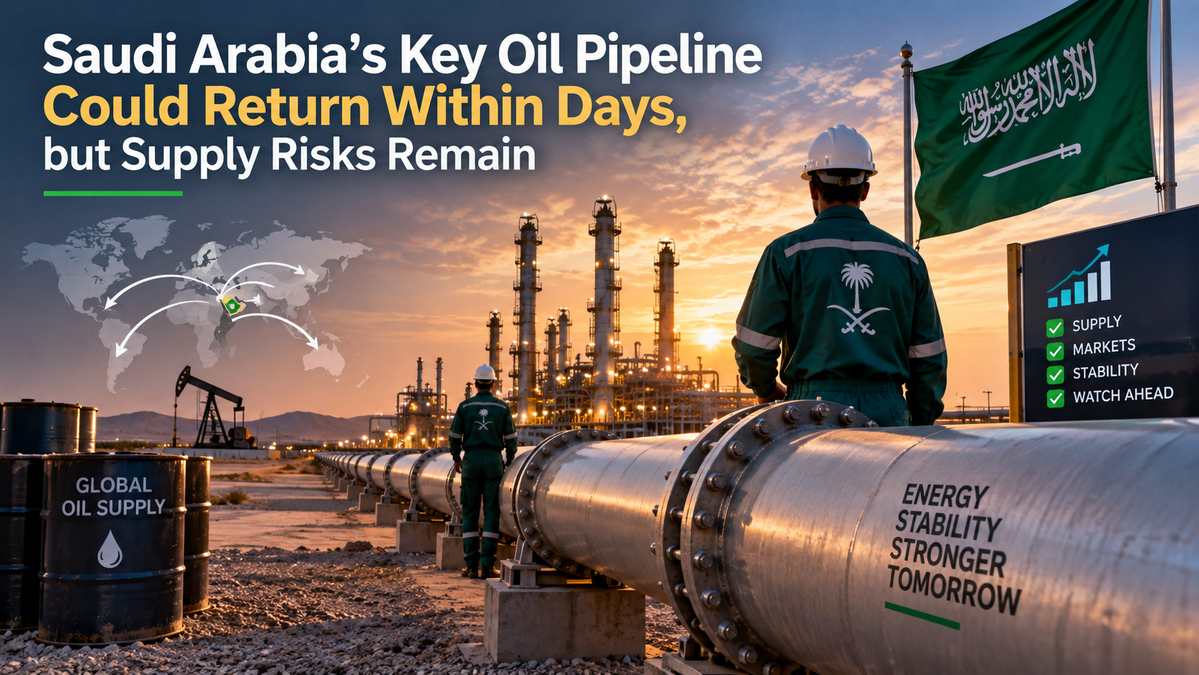
Saudi Arabia may be only days away from restoring one of its most important oil-export routes, offering a potential relief point for a global energy market already dealing with severe supply disruptions.
U.S. Energy Secretary Chris Wright said Tuesday that crude oil could begin flowing again through Saudi Arabia’s East-West Pipeline within days. His comments came after the strategically important pipeline was temporarily shut following attacks by Iran-aligned groups.
The expected restart is significant because the pipeline has become much more than a piece of Saudi infrastructure. With shipping through the Strait of Hormuz heavily disrupted, it has provided an alternative route for moving Saudi crude toward the Red Sea and international markets.
But there is still a major question hanging over the announcement: Can the pipeline really return to meaningful operation within days, or will repairs take considerably longer?
A Race Against the Clock
Speaking at a G20 energy meeting in Houston, Wright said the repair timeline was still being assessed but that he expected it to be measured in days.
That is encouraging news for oil markets, but it is not yet a guarantee.
Reuters reported that sources familiar with the situation offered different estimates for the repair work. One source said the damage could require five to six weeks to repair, while another suggested that pumping could resume sooner, potentially on a partial basis while repairs continue.
That uncertainty matters.
The difference between a pipeline restarting in several days and remaining offline for several weeks could have a substantial effect on crude supplies, shipping patterns and prices.
Why This Pipeline Matters So Much
Saudi Arabia’s East-West Pipeline stretches about 1,200 kilometers across the Arabian Peninsula.
Under normal circumstances, it provides Saudi Arabia with a way to transport crude from oil-producing areas in the east toward the Red Sea in the west. That allows shipments to reach international markets without having to pass through the Strait of Hormuz.
The pipeline has reportedly been carrying between 4 million and 5 million barrels of oil per day, equivalent to roughly 4% to 5% of global oil supply.
Think of it as an emergency bridge for the world’s oil market.
When the usual route becomes difficult or dangerous, this alternative route becomes far more valuable.
That is exactly why its shutdown has attracted such intense attention.
The Strait of Hormuz Is at the Center of the Problem
The pipeline’s importance has increased because the Strait of Hormuz has been heavily disrupted during the ongoing conflict involving Iran.
The narrow waterway between Iran and Oman is one of the world’s most important energy corridors. With shipping through the strait severely affected, Saudi Arabia and other producers have faced increasing pressure to find alternative ways of moving oil.
The East-West Pipeline has provided one of those alternatives.
Its temporary closure therefore creates a problem at precisely the moment when Saudi Arabia needs additional flexibility.
Reuters reported that Saudi Arabia is taking steps to move more oil away from the Strait of Hormuz with assistance from the U.S. military.
The Damage Is More Than a Local Infrastructure Problem
The pipeline attack may have occurred inside Saudi Arabia, but its consequences extend far beyond the kingdom.
Oil is traded globally, meaning a disruption to a major export route can affect buyers thousands of miles away.
Indeed, Reuters reported that Saudi Arabia had already cut some oil shipments to Europe following the damage to the pipeline and that buyers were looking for alternative supplies.
This is where the story becomes particularly important for consumers.
A prolonged disruption can affect crude prices first. Higher crude prices can then feed into refinery costs, transportation expenses and eventually fuel prices.
The impact does not necessarily appear immediately at the gas station, but energy markets tend to react quickly to the possibility of tighter supply.
Oil Markets Are Watching Every Day of the Shutdown
Oil prices have already responded to concerns surrounding Saudi supply.
Reuters reported that crude prices settled about $3 higher on September 15 after concerns over the Saudi pipeline and further attacks increased fears about available supplies.
The market reaction shows why the expected pipeline restart is being watched so closely.
If significant volumes return quickly, some pressure could ease.
If repairs take weeks, however, traders may continue to price in the possibility of tighter supplies.
This makes the pipeline’s operating status an important daily indicator for the energy market.
The Biggest Question: Full Restart or Partial Operation?
One detail could make a major difference.
A pipeline does not necessarily have to be completely repaired before oil movement resumes.
According to Reuters, one source indicated that the system could potentially begin pumping again on a partial basis while repair work continues.
That possibility could provide some relief even if the entire system is not immediately restored.
For oil consumers and traders, therefore, the next important announcement may not simply be whether the pipeline is “back online.”
The more meaningful question will be how much oil it can safely move.
Saudi Arabia Is Trying to Keep Exports Moving
The pipeline shutdown comes at a difficult time for Saudi Arabia.
The kingdom needs to maintain access to international customers while several traditional routes are under pressure.
Reuters has reported that Washington has so far resisted Saudi requests for direct military intervention beyond intelligence assistance.
Meanwhile, Saudi Arabia has been working on ways to move more oil through alternative routes.
That makes infrastructure resilience increasingly important.
The crisis demonstrates that having large oil reserves is not enough. A country also needs functioning pipelines, ports, shipping routes and secure transportation corridors to turn those reserves into actual exports.
A Wider Warning for Global Energy Security
The current situation highlights a vulnerability that extends well beyond Saudi Arabia.
Modern energy systems depend on a relatively small number of critical transportation routes. When one pipeline, port or maritime corridor is disrupted, the consequences can spread quickly through international markets.
The East-West Pipeline was designed partly to give Saudi Arabia greater flexibility by reducing its dependence on the Strait of Hormuz.
Yet the latest attack shows that alternative infrastructure can itself become a target.
That creates a difficult challenge for energy planners: How do you build an alternative route when the alternative can also be disrupted?
What Happens Next?
For now, the market is waiting for evidence rather than relying solely on forecasts.
Chris Wright expects the Saudi pipeline to be operational again within days, but other estimates reported by Reuters suggest the repair process could take considerably longer.
The next few days should therefore provide important clues.
If the pipeline resumes substantial flows quickly, it could remove some pressure from a market already worried about supply shortages.
If repairs stretch into weeks, the disruption could become a much bigger problem for Saudi exports and international oil markets.
For now, the message is cautiously encouraging rather than definitive: Saudi Arabia may be close to restoring a crucial oil lifeline, but the speed and scale of the restart remain uncertain.
And in today’s tight energy market, every day that pipeline remains offline matters.